


When the Workflow Holds Still
Most business software rests on a comforting assumption: the workflow is knowable. Take a CRM. The steps a lead moves through, the fields a contact record needs, the stages of a deal — these are well understood before a single line of code is written. The problem is reasonably well defined, and the software’s job is to take that defined problem and handle it reliably, at scale, without drama. Success is measured in dependability: does it do the known thing, every time, for everyone?
This is the world most of the software industry grew up in. Gather requirements, specify, build, test, deploy. Lock down what the system needs to do, then engineer something that does it well. In our experience building these kinds of applications, the discipline pays off precisely because the target stops moving. The workflow is a stable thing you can study, encode, and automate — and when you get it right, it simply runs.
When the Workflow Won’t Hold Still
Research informatics runs on the opposite assumption. Here, the workflow is the variable. The goal of a research ELN or an assay data management system is not to enforce one correct process — it is to capture and manage data from workflows that change constantly, sometimes week to week, as the science itself evolves. A scientist does not run the same assay the same way forever. They modify it, branch it, invent a new readout, abandon an approach that isn’t working. The software that serves them has to bend when the science bends.
Success here is not measured by whether the system does one known thing dependably. It is measured by whether it can accommodate the thing nobody could have specified up front — because at the moment of specification, the workflow had not been invented yet. That is the disorientation our software veteran was feeling. Every instinct told him to pin down the requirements first. But in research, the requirements are legitimately unclear — not because the customer is disorganized, but because the work is discovery, and discovery doesn’t hold still long enough to be specified.
The Category Error
Here is where it gets expensive. The industry’s conventional wisdom about software failure is nearly unanimous: projects fail because of unclear requirements. Read almost any post-mortem of an informatics rollout and you will find the same diagnosis — the requirements weren’t nailed down.
For business software, that is true, and the fix is obvious: do better discovery, write tighter specs. But apply that same fix to a research problem and it backfires. You produce a rigid system built to a frozen snapshot of a workflow that has since moved on — and the scientists route around it, keeping their real work in spreadsheets and notebooks while the expensive platform sits half-used.
The reverse error is just as costly. Bring the open-ended flexibility of a research mindset to a genuine business problem and you get scope creep with no natural end state — a project that never ships because “just one more configuration” is always around the corner. The mental model is the thing that doesn’t transfer. Not the talent, not the engineering skill — the model of what done even means.
Order vs. Chaos: The Zone Where They Collide
And then there is the space in between, where most of the hardest projects live. Quality systems, most LIMS, manufacturing-oriented ELNs — these exist almost to enforce the order of business systems upon the chaos of discovery research.
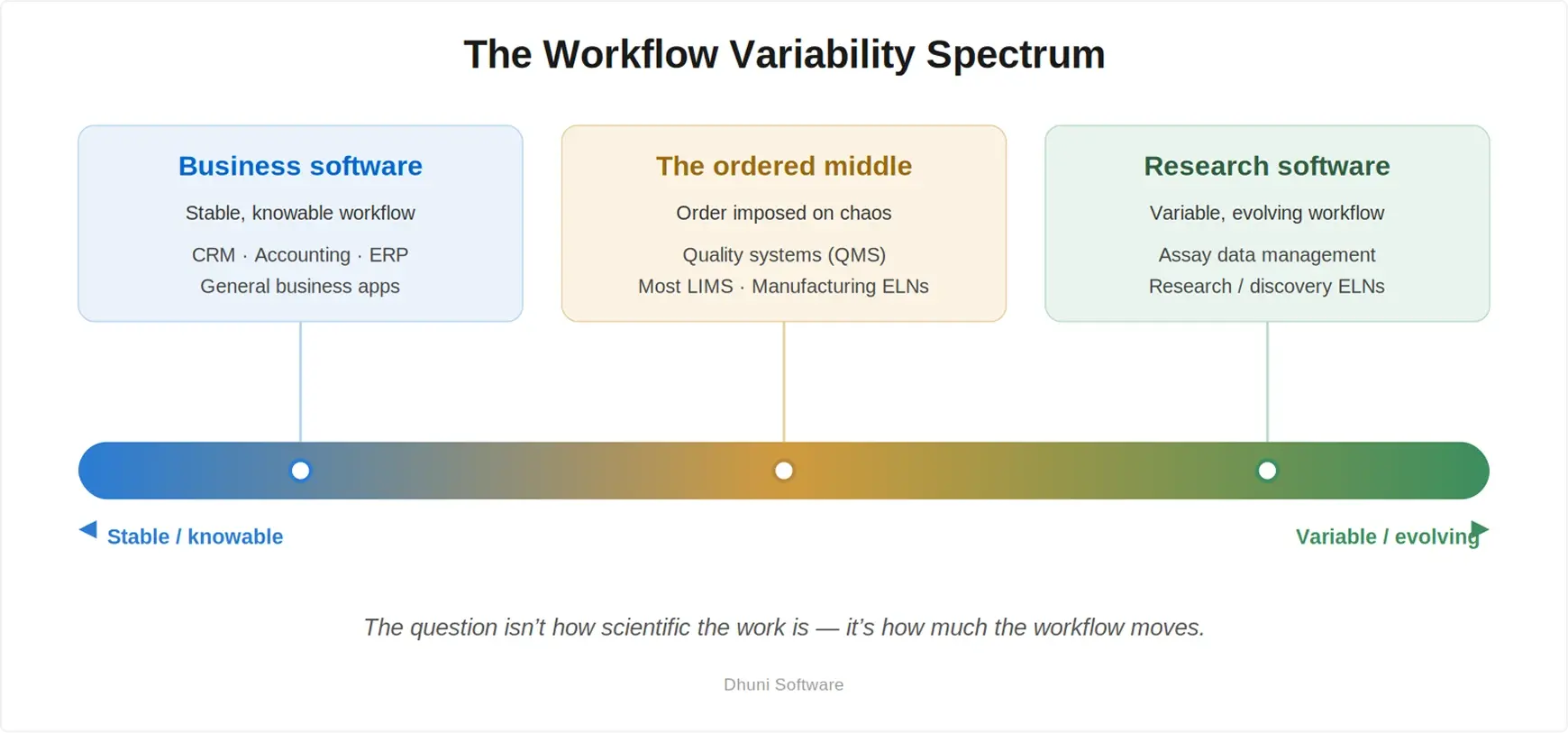
It is worth noticing that scientific is the wrong word for the ordered end of this spectrum. Manufacturing science is one of the most rigorously defined, least variable workflows there is. The axis here isn’t whether lab coats are involved — it is how much the workflow moves.
These middle-zone systems are the hardest to scope precisely because they are both things at once. They have to impose enough structure to be trustworthy and compliant, while accommodating enough variability to survive contact with real research. Approach one with a pure business-software mindset and it is too rigid to adopt. Approach it with a pure research mindset and it is too loose to validate. Getting it right means holding both models in your head at the same time.
Diagnosis Before Prescription
None of this means one kind of software is harder or better than the other. It means the first question on any life sciences software project isn’t “what features do you need?” It is “how much is this workflow going to move?”
Answer that honestly and everything downstream gets clearer: how you gather requirements, what “done” looks like, whether you are buying stability or buying flexibility. Get it wrong and you will bring the right tools to the wrong kind of problem. Because Dhuni builds across all three zones — business applications, research software, and the difficult middle — that diagnostic question is where we start. Not with the feature list. With the shape of the chaos.


